

A budget can look responsible on paper and still fail to produce savings. The breakdown usually happens in a few predictable places: the plan ignores bill timing, leaves out less frequent expenses, or assumes saving will happen with whatever is left at the end of the month. The CFPB recommends building an “as-is” budget from actual spending, including less frequent costs and a miscellaneous category, then checking whether the leftover amount in the budget matches what is really left in the account. (consumerfinance.gov)

A monthly total can hide a cash-flow problem
Some budgets fail even when the monthly math seems fine. The reason is cash flow: money coming in and money going out are not lining up. The CFPB notes that if income and expenses are out of sync, it is easy to run short near the end of the week or month even if the overall budget technically balances. (consumerfinance.gov)
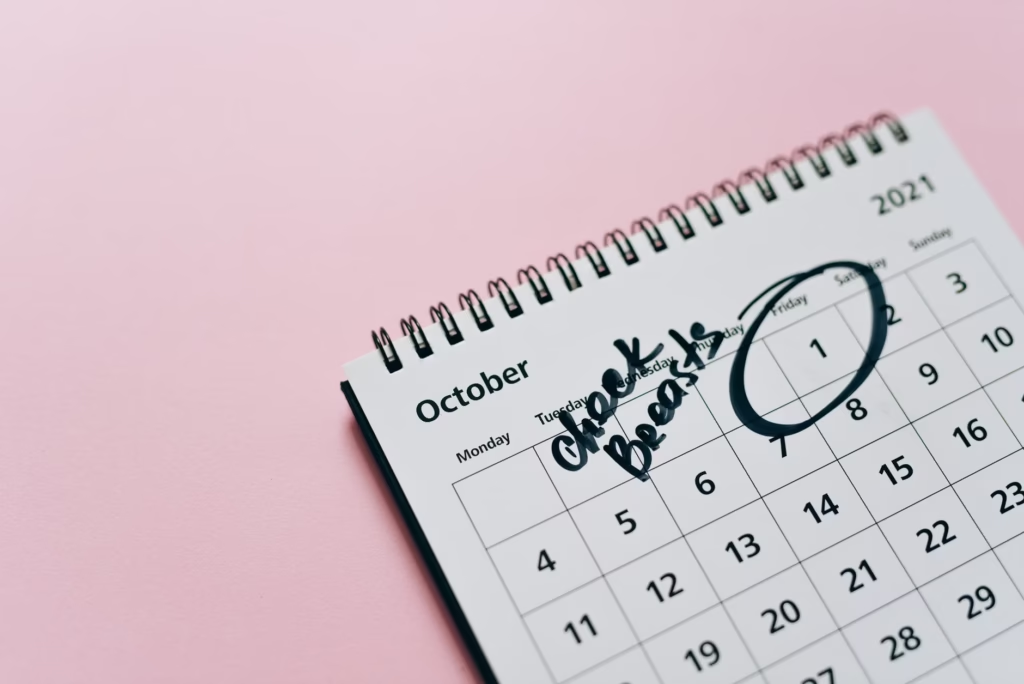
That is why a working budget needs a calendar, not just categories. Put paydays and bill due dates in the same place and look for clusters. If a recurring bill regularly lands at the wrong time, it may be worth asking whether the due date can be changed. This matters even more for biweekly pay, freelance income, seasonal work, or any household where cash arrives unevenly. If income is irregular, Consumer.gov suggests estimating monthly income using last year’s total income divided by 12 instead of building the plan around a strong recent month. (consumer.gov)
Irregular costs are not really surprises
A budget often looks balanced only because annual, quarterly, or occasional costs were left out. The CFPB advises looking back over several months so you do not miss less frequent expenses such as insurance, medical bills, school costs, gifts, charity, vacations, and other seasonal spending. It also recommends keeping a miscellaneous category because there is almost always something out of the ordinary. (consumerfinance.gov)
The practical fix is to turn predictable nonmonthly costs into monthly placeholders. If car insurance is due twice a year, part of that bill should be set aside every month in a separate sinking-fund category or savings bucket. Consider a simple hypothetical example: a budget says there is $150 left over each month, but that extra cash disappears as soon as a semiannual insurance premium or school fee arrives. The money was never truly available for long-term savings; the expense was just hidden. (consumerfinance.gov)
Saving only the leftovers is often the biggest mistake
Many people budget for bills and spending first, then hope savings happens naturally. A stronger approach is to treat savings as part of the plan itself. Consumer.gov notes that savings can be included as one of the expenses in a monthly budget, and the CFPB recommends creating a consistent contribution system rather than waiting to see what survives month-end. Automatic recurring transfers or splitting direct deposit can make saving happen before day-to-day spending expands to fill the checking account. (consumerfinance.gov)
There is an important nuance here. Small round-up or spare-change features can help build the habit, but CFPB research found that guaranteed saving rules, such as saving every payday, were associated with better savings outcomes than rules tied to spending, such as rounding up each purchase. At the same time, automation is not something to set and forget blindly. The CFPB warns that automatic transfers can contribute to overdraft fees if there is not enough money in checking when the transfer hits. If income is tight or variable, reduce the transfer amount, move the transfer date, or schedule it only after pay has cleared. (consumerfinance.gov)
A 15-minute budget reset is usually more useful than starting over
When a budget is not producing savings, a quick reset often works better than downloading a brand-new template. The goal is not to create a prettier plan. It is to make the current one more realistic. (consumerfinance.gov)
- Pull the last two or three months of checking and card statements and build an as-is budget from what actually happened, not from what should have happened. (consumerfinance.gov)
- If income is irregular, estimate an average monthly income using a longer look-back rather than your best month. Consumer.gov suggests using last year’s total income divided by 12. (consumer.gov)
- List every less-frequent expense you can find and give it a monthly placeholder amount. Keep a miscellaneous line for the odd costs that never seem to fit neatly anywhere else. (consumerfinance.gov)
- Put paydays and bill due dates on one calendar so timing problems become visible. If one bill is always colliding with another, ask about a different due date. (consumerfinance.gov)
- Schedule savings as a recurring transfer or split direct deposit, then compare the budget’s expected leftover with what is actually left in the account at month-end. If the numbers do not match, the budget is still missing something. (consumerfinance.gov)
A useful budget is less about self-control than accuracy. When it reflects real timing, real irregular costs, and a real savings transfer, saving money stops depending on luck or leftover willpower. That is usually the difference between a budget that feels responsible and one that actually leaves money in the bank. (consumerfinance.gov)
References
- Consumer Financial Protection Bureau – Assess your spending – https://www.consumerfinance.gov/owning-a-home/prepare/assess-your-spending/
- Consumer Financial Protection Bureau – An essential guide to building an emergency fund – https://www.consumerfinance.gov/an-essential-guide-to-building-an-emergency-fund/
- Consumer Financial Protection Bureau – Consumer Savings App Strategies and Savings Outcomes – https://www.consumerfinance.gov/data-research/research-reports/consumer-savings-app-strategies-and-savings-outcomes/
- consumer.gov – Making a Budget – https://consumer.gov/your-money/making-budget